One of the most mind-blowing things for me after the kids were diagnosed, was terminology. There’s so many new things to learn, it can feel like speaking a new language. The Autism Society of NL (ASNL) updated their website in the last couple of years to include a page strictly for terminology so that’s a great resource for anyone who wants to know more. Imma talk about some of the ones we use on the regular and how it relates to my kids.
Stimming – The repetition of movements or sounds. I talk about this a lot because both of my kiddos stim quite frequently. Penny’s stims are pretty noticeable – she rocks back and forth, jumps with her arms in the air while tensing up and yelling loudly. Rory’s stim is pretty subtle – he flexes his hand/fingers and might rub his hand against his face or mouth while bending his fingers. We try not to prevent the kids from stimming unless they’re going to hurt themselves or others (there’s a lot of research as to why), but it can sometimes indicate that a sensory need isn’t being met, so we might address that. Usually it’s just that they’re so incredibly happy and excited that they show it physically.
Fun fact: everyone stims. Do you ever tap a pen on a desk? Bite your nails? Twirl your hair? Jiggle your foot? Most people can recognize when it is or isn’t socially acceptable and may stop if they’re interfering with or annoying someone (my kids don’t stop haha). Also, Penny’s stimming makes for awesome pictures, such as the one below where she appears to be summoning Poseidon.

ADOS – Autism Diagnostic Observation Schedule (I just looked up what it actually stands for). The ADOS is the assessment done by the Paediatrician to diagnose autism. I could/will probably do a whole post on the ADOS. I had never heard of it before Penny was scheduled for hers.
ABA Therapy – Applied Behavioural Analysis. This is the most common therapy for Autism. It sounds really intensive, but it’s all play-based and I literally just always told my kids, “are you going to go play with *ABA therapist’s name*?” I could do a whole post on ABA too. We found it super helpful for the kids, but not everyone loves it. My favourite part was a program for toilet training. Doing toilet training with help from professionals? Yes, please!
JASPER – Joint Attention, Symbolic Play, Engagement Regulation. This is a new therapy available in Newfoundland and Labrador and I’ve been singing it’s praises. It’s a program run out of UCLA through Eastern Health and basically it teaches kids how to play. Playing and playing with someone comes naturally to a lot of kids, but not to mine. My kids did it in the trial phase while everyone was trying to get fidelity (to be certified, basically) and they loved it. It’s more structured and kid-run than ABA and is usually an hour or so a week (where ABA can be up to 30 hours/week).
ST – Senior Therapist. These are the lovely humans/Child Management Specialists who develop programs for ABA Therapy. We’ve had the same Senior Therapist with Penny since she was diagnosed in 2016, and after Rory going through a few because of staffing changes, he now has the same one as Penny. I refer to her as my Yoda…I don’t think she knows that.
OT – Occupational Therapy or Therapist. I’ve gotta be honest that I don’t know how to define them. They help with every day skills. Kid stimming a lot? OT. Kid has trouble writing? OT. Kid won’t eat? OT. They pretty much help with everything. We work with ours mostly to find solutions for Penny’s need for a lot of Gross Motor Movement (the big movements). If you want an actual definition, you can google it. There are OTs provided through the Janeway Child Development, but you can hire private OTs as well.
Speech/SLP – Speech Therapy and Speech Language Pathologist. These are the people who help our kiddos communicate, and they usually give a lot of suggestions to parents on how they can help. It’s also not all about verbal communication – they can help the kiddos learn PECS and any Speech apps as well. You get assigned an SLP through the Janeway, but once the child hits school age they’re no longer eligible, so you can hire a private SLP (which can be partially covered by insurance).
HT – Home Therapist. This is the person the family hires to do ABA Therapy with their kiddo. Sometimes referred to as ABA Therapist. We’ve had a total of three and they’ve all been wonderful. It’s only a two day course to become an ABA Therapist, so I feel there also has to be a natural ability to relate to the kiddos, be creative, and work well with them. The parent is responsible for sending in payroll for the HT, but Eastern Health is the one who pays them.
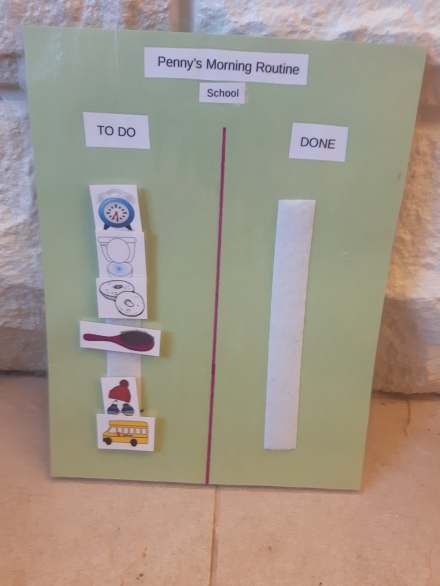
Visual Schedules. They’re exactly what they sound like. Schedules, but with pictures. I love visuals. I use them for everything. Rory isn’t a fan really, but Penny loves them. We often use visual schedules like the one below to get through our day. Sometimes the kids struggle with a change in routine, understanding multi-step instructions, or wondering what’s supposed to come next, so visuals definitely help. Almost everyone uses visual schedules – do you have a To-Do list or a Meal plan done for the week? That’s a visual schedule, just with words instead of pictures.
IRT: Instructional Resource Teacher. These are basically what used to be known as the “special needs” teachers in school. Penny loves hers!
SA – Student Assistant. The person who hangs out with Penny during the day at school, mostly to watch her in case she runs. They may help with toileting, and helping her to do her work during the day.
ISSP – Individual Support Services Plan. I had to google the actual meaning again. This is the meetings we have (usually every 6 months) with all the kids’ professionals (separate for each child) and make a plan for the next six months. The school ones are the most intense because we aim for it to be: parent(s), ST, IRT, Guidance Counsellor, Autism Itinerant, Speech from school, speech from Janeway (or private speech), OT, our Social Worker, the principal, classroom teacher, and HT (if relevant). We come up with specific goals based on their age, behaviours, and their strengths and needs.
IEP – Individualized Education Plan. Sometimes called IPP. Only Penny has this because she’s my only kid in school. Rory will have his own when he starts. This is goals that the school is teaching Penny outside of regular classes. There’s usually an insert in with the report card which documents how she did with each individual goal. We help come up with the goals at the ISSP meetings based on her strengths and needs.
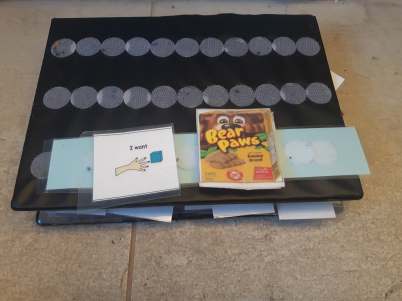
PECS – Picture Exchange Communication System. When your kiddo is having hard time communicating, this helps develop communication and language. It’s usually a binder that with a “sentence strip” with velcro on the front, and it’s filled with all kinds of picture of preferred objects. The goal is to have the kiddos eventually request using the sentence strip. Like, “I want Bear Paw” (Rory’s fave). You would think that giving the kids a way to talk with pictures would hinder their speech but it actually helps enormously. And plus it gives them a way to communicate without screaming or dragging you to the cupboard every half an hour to get the bear paws.
Meltdown – A strong reaction to being overwhelmed. Even though this can look like a behavioural thing, it is not a tantrum. The main differences being that it’s very hard to calm and it can happen whether or not there is an audience. It’s often related to sensory overload or anxiety. It could be that it’s too noisy and you can’t escape. There is a change in routine and you’re anxious. Also, sensory overload doesn’t always result in explosive behaviour – Rory was so overwhelmed at the Wiggles concert last year, he passed out cold. As parents, we are pretty good about spotting the meltdowns and triggers before they happen now, therefore preventing most, but life happens. Penny has meltdowns if we check the mail on the way back to our house – not if we check on the way out, just on the way home. Like, why?!
Echolalia – Repeating words or phrases. This is usually how Penny communicates. Instead of coming up with a way to respond, she’ll reference a previous conversation. When she gets upset, instead of telling me why, she will often yell out, “go to Wal-Mart!”. She doesn’t actually want to go to Wal-Mart, she just can’t say, “I don’t want to get a bath, mother, leave me alone.” When I ask her how school was today, she’ll say, “So much fun at school”. If I then ask her what she did at school, she’ll repeat, “so much fun at school”.
Elopement – wandering or running away. My kids have a tendency to wander and is one of their most stressful behaviours. We have special locks on our doors and have taken the handles off of our windows for a certain little girl who tries to escape the house on a regular basis. We’ve lost both kids once (Penny ran away in St. Shotts and Rory got out of our house in Mount Pearl) and it is a terrifying experience, especially when they don’t respond to their name and have no concept of danger. The other day Rory almost got out of the park, and when Shamus caught up to him I heard Penny say, “Noooo…try again, Rory!”. When you catch Penny running away she yells at the top of her lungs, “Oh! Sooooo close!!!”.
Inclusion Worker – Extra support person at Daycare. I think they might be called “ratio enhancement” now. It’s an extra hand to help out with a special needs child at daycare. We struggled to find daycares who were open to an inclusion worker (which is a human rights issue – but that’s another story in itself). Rory starts a wonderful daycare in two weeks and will have an inclusion worker there. The daycare is responsible for hiring the extra staff, but the provincial government is the one who pays them.
If there’s any more terms you’d like to know more about, let me know. It comes second nature to us now, so I don’t know what’s general knowledge or not. I’ll add more as I think of them.
 A Manageable Amount of Chaos
I learned a lot. I hear those terms regularly but did not really know what they meant. I love the pictures and the examples. It made me laugh out loud.
LikeLike